
Your spark plugs are like a cipher.
And to read a cipher code, you usually need a cipher key. That’s what this is—a cipher key that is going to help you “read” your spark plugs and understand what they’re telling you about how your engine is running.
Is your engine running too rich? Too lean? Could there be a problem with ignition timing, or your oil system?
The answers are often in your spark plugs, and by using this chart to diagnose your engine’s performance, you’ll be able to make whatever adjustments might be necessary to achieve peak performance.
***
Story Summary Overview
- Visually inspecting your spark plugs after use can offer clues into the health of your engine
- The process is known as “reading” your plugs, and it gives you a window into what’s going on in your engine’s combustion chamber
- Potential spark plug related issues stem from improper air/fuel mix, oil sealing, and ignition timing
- Visual spark plug inspection is a pretty straightforward, yet can provide significant insight
- This visual infographic explains what to look for, and the article below offers some potential causes & solutions
***
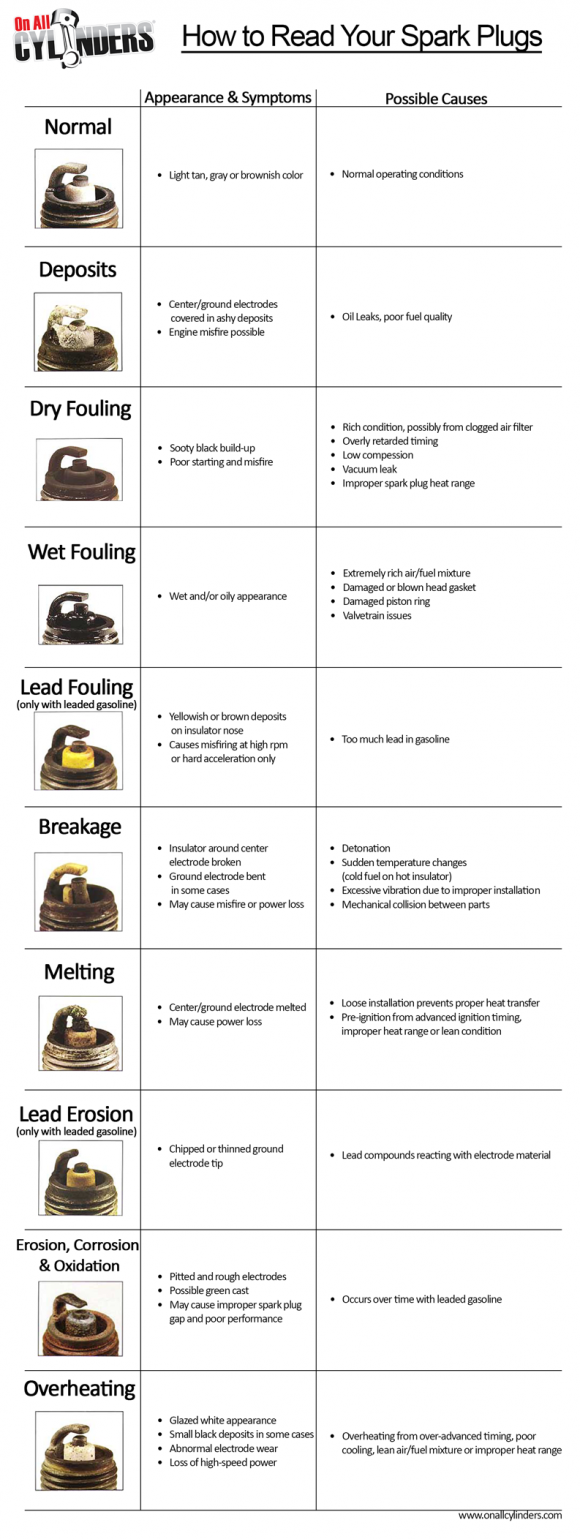
How to Read Your Spark Plugs to Detect Engine Problems
With help from the spark plug experts at NGK, we’ll teach you how to diagnose minor tuning issues or potentially major engine problems by examining your spark plugs. Check out the descriptions below and you’ll learn how to interpret your spark plus to remedy whatever issue your engine is faced with.

Normal
- Appearance: A light tan/gray or brownish color, along with very little electrode erosion, indicates optimal operation conditions, including a healthy engine and correct spark plug heat range.
Deposits
- Appearance & Symptoms: The electrodes—center and ground—are covered in an ashy coating. As a result of this masking of the electrodes, your engine may experience a misfire. This build-up of combustion deposits can eventually (but not usually) fill in the space between the two electrodes.
- Possible Causes: Oil leaks, poor fuel quality.
Wet & Dry Fouling
- Appearance & Symptoms: Dry fouling (top) appears as sooty, black build-up. Wet fouling (bottom) has a wet, sometimes oily appearance. Both conditions can create poor starting and misfiring.
- Possible Causes: Depending on whether the spark plug is coated in oil or fuel, wet fouling can be symptomatic of a compromised head gasket, poor control from your pistons’ oil control ring, valvetrain problems, or an extremely rich condition. Dry fouling, or carbon fouling, is often caused by an overly rich condition, and the problem may lie with your air cleaner (clogged) or carburetor. Other possible causes could be low compression, vacuum leak, overly retarded timing, or improper spark plug heat range.
Lead Fouling
- Appearance & Symptoms: Lead fouling can only occur in applications that use leaded gasoline, such as racing engines. Lead fouling generally shows up as yellowish brown deposits on the spark plug’s insulator nose. Lead fouling can cause your engine to misfire only at high-rpm and under hard acceleration.
- Possible Causes: This condition commonly occurs when gasoline contains too much lead; however, because spark plugs are changed frequently in racing applications, lead fouling has become less common.
Breakage
- Appearance & Symptoms: The insulator around the center electrode may be broken (see left) or the ground electrode may be bent. Again, you will likely experience misfire and some power loss under these conditions.
- Possible Causes: If the insulator is broken, it may be the result of sudden thermal expansion or thermal shock caused by extreme temperatures or temperature change. Detonation is often the culprit and can be caused by an extremely lean air/fuel mixture, drastically advanced timing, improper gasoline octane rating. A broken insulator can also be thermally triggered if cold fuel is sprayed on a hot insulator. Center and ground electrode damage is often the result of mechanical collision with internal engine components or excessive vibration. The mechanical collision occurs when a spark plug has too long of a reach. Vibration is generally the result of improper installation.
Melting
- Appearance & Symptoms: In this case, the center or ground electrode is melted or scorched, and your engine may be experiencing some power loss.
- Possible Causes: According to NGK, melting often results from loose installation, which prevents the plug from properly transferring heat from its tip. But melting may also indicate unusual heat or hot spots within the combustion chamber. This excessive heat is often the result of pre-ignition, which can be created by an overly lean condition, improperly advanced injection timing, or improper heat range (too low).
Lead Erosion
- Appearance & Symptoms: The tip of the ground electrode looks chipped and its surface may be thinned.
- Possible Causes: Another condition unique to leaded gasoline, this condition is caused by lead compounds that react chemically with the electrodes at high temperatures. This makes the electrode material (nickel alloy) weak and brittle. This is caused by too much lead in your gasoline.
Erosion, Corrosion & Oxidation
- Appearance & Symptoms: A plug with a combination of erosion, corrosion, and oxidation will have pitted and rough electrodes and may even have a green cast if the oxidation is heavy. These conditions can result in increased, improper spark plug gap and yield poorer performance.
- Possible Causes: Typically, these conditions occur over time as lead in the gasoline reacts with the electrode materials.
Overheating
- Appearance & Symptoms: The insulator will have a glazed white appearance and may have small black deposits. There may also be abnormal electrode wear, and you will likely notice a loss of power at high speeds or under high engine load.
- Possible Causes: Overheating may occur from over-advanced ignition timing, poor cooling system efficiency, lean air/fuel mixture, vacuum leak, or wrong spark plug heat range (too low).


Good morning, I am and I live in Veneuela, I would like you to inform me if they have and the cost of Bujias for a FX4 FORD 2008 2008 minivan cab and half motor 5.4. SP 515.
Thanks greetings.
Que marca quiere? Motorcraft son casi $4 cada uno.
[…] should also check your spark plugs. If they have any oil deposits or oil on the threads, you may have a vacuum leak that is pulling […]
que pasa si la calibracion de las bujias de mi auto es 52 a56 y me las calibraron a 35 gracias por atender mi pregunta buen dia.jose