
I’m building a small block Chevy and I think it would make more compression if I could mill the heads to drop combustion chamber volume from 76cc to 70cc, but I don’t know how much to tell the machine shop to mill off the heads. Can you help?
E.P.
The general rule of thumb is to remove 0.006-inch from the deck surface of the head to lower the volume of the combustion chamber by 1cc. To reduce the chamber size from 76cc to 70cc will require milling the heads 0.036-inch. This is quite a bit of material to remove from the deck surface. If you do this, it’s likely that when you bolt the heads on the engine, the intake manifold bolts will not line up with the intake bolt holes in the heads. That’s because the heads are now substantially shorter. You will have to mill the intake manifold flanges in order to line them up again.
This major milling will also mean using shorter pushrods because now the heads are 0.036-inch closer to the block. All of this will require a substantial cost in machine work and assembly time. You will also need to double check to make sure the intake manifold is actually parallel with the intake port surface on the heads. Milling tends to change this angle.
If the intake ports are not parallel, there will be a gap between the intake manifold sealing surface and the bottom of the port surface on the heads. This gap will not allow the intake bolts to clamp and seal the intake gasket. This is a very common problem with small blocks where the deck or head surfaces have been extensively milled. We will not go into the procedure on how to check this, but these articles will give you the details:
Head Milling 101: The Basics of Head Milling to Gain Compression
Mailbag: Mating and Sealing Tips for Milled Cylinder Heads
Ask Away with Jeff Smith: Lining Up Intake Manifold Bolt Holes on a 427 Chevy
You didn’t mention the size of your engine but we will assume for the purposes of this answer that it is 355 cubic inches. We put your current engine combination into Summit’s free compression ratio calculator. We’ll assume a flat top, four-eyebrow 0.030-inch over piston, a bore of 4.030 inches, and a 3.48-inch crank stroke. We will also assume the piston will be 0.015-inch below the block deck using a 0.040-inch thick composition gasket and a 76cc head. That combination will produce a compression ratio of 8.77:1.
Assuming you don’t want to change pistons since that involves a major rebuild, the best solution is to find a set of cylinder heads with smaller chambers. A set of Summit Racing Vortec heads with a 64cc combustion chamber will instantly boost the compression from 8.77:1 to 9.91:1. This is on the ragged edge of what might be compatible with 91 octane premium fuel with aggressive ignition timing, but it would also make your engine really snappy and throttle responsive.
Another option would be a set of aftermarket heads with a 72cc chamber. Summit Racing offers an affordable cast iron small block Chevy head with 165cc intake ports, 72cc chambers, 2.02-/1.60-inch valves, and springs set up for a flat tappet camshaft with a maximum lift of 0.490-inch. Using a much thinner 0.015-inch Fel Pro rubber-coated head gasket with these heads would increase the compression ratio to 9.63:1, which works well with 91 octane fuel and mild cam timing.
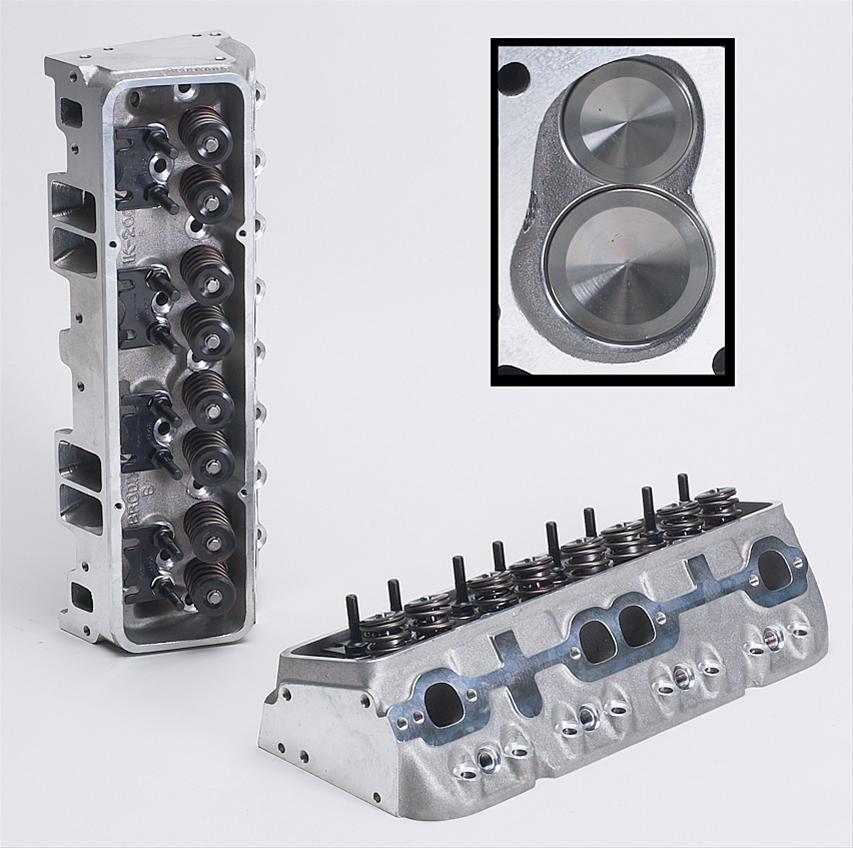
Another option would be an aluminum head with 70cc chambers. We’ve had experience with the Iron Killer (IK) head from Brodix with 180cc intake ports and 70cc chambers. These heads offer excellent flow potential for more power and offer a compression ratio of 9.31:1 with a 0.040-inch head gasket. That ratio is very compatible with 91 octane fuel.
Parts List
Summit Racing Vortec Cast Iron Cylinder Head SUM-151120
Summit Racing Cast Iron Cylinder Head SUM-152123
Brodix IK 180 Aluminum Cylinder Head, 70cc chamber BRO-1021002
Fel-Pro Performance Head Gasket, 0.015″ thick FEL-1094
Fel-Pro Performance Head Gasket, 0.040″ thick FEL-1142


Comments