
I recently built a 355ci small block Chevy with a flat tappet camshaft. We started the engine and ran it for less than 10 minutes at around 2,000 RPM when headers turned cherry red. We decided to shut the engine down and let everything cool off since that didn’t seem right. My friends tell me the engine is running way too lean and that’s the reason for the cherry red headers, but I’m not sure. The engine seems to run fine but I’m not sure what to do to correct this problem. Any suggestions?
D. S.
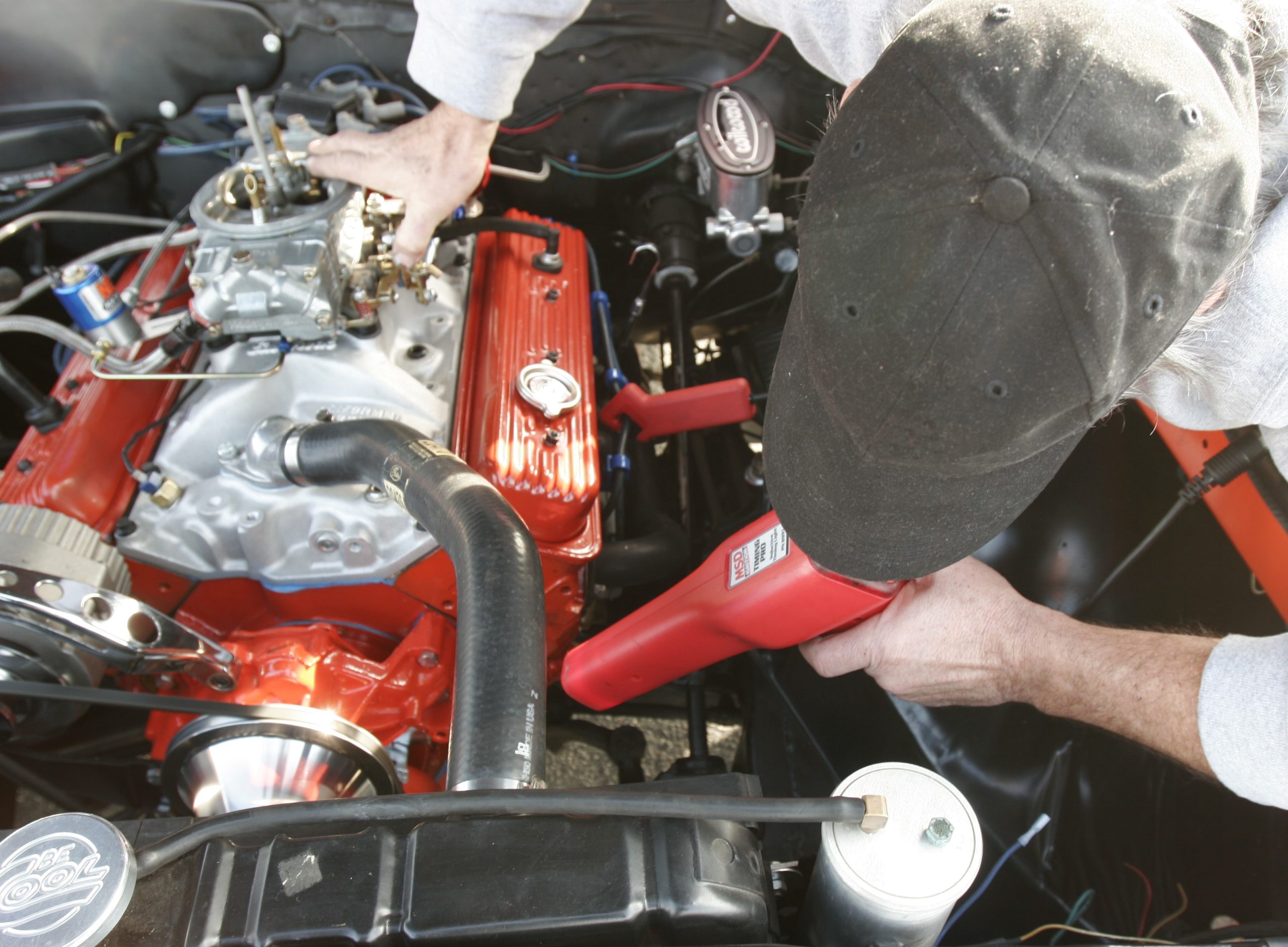
We’ve seen this situation several times. In nearly every case, the online experts immediately proclaim that the engine is too lean and needs to run a richer air-fuel ratio. This is false. Your issue may in fact be a combination of too much fuel at part-throttle and insufficient ignition timing. Let’s go over why this happens.
Ignition Timing
Let’s start with ignition timing. Perhaps your engine has a distributor with a stuck or rusty mechanical advance mechanism that prevents the advance curve from moving properly. If you’re using a new MSD distributor, be aware it is factory-fitted with the strongest mechanical advance springs. MSD does this so the distributor has the slowest advance curve to prevent engine detonation. Combine that with the factory-installed black advance bushing that limits total advance to only 18 degrees and you get an ignition curve that doesn’t fully come in until 4,400 RPM.
A far better recommendation would be to set up the distributor so the ignition curve is adding at least another 15 degrees of timing by 2,000 RPM. With 15 degrees initial and 15 degrees of mechanical advance, the engine is now initiating spark 30 degrees Before Top Dead Center (BTDC).
Frankly, this still might not be enough to ensure the headers will not turn bright red. That’s why we suggest running a distributor with vacuum advance on a street engine. With a functioning vacuum advance at no load (high vacuum), you would have another 12 to 14 degrees of advance at 2,000 RPM for a total of 40-plus degrees of total ignition advance. This will light the spark early enough so the combustion process is completed before the exhaust valve opens.
With late or retarded ignition timing, combustion begins much later than it should. Contrary to your 10th grade science class description of combustion, the process is not an instantaneous explosion but more like a prairie fire burning across the top of the piston and combustion chamber. If the fire begins too late, it will still be burning when the exhaust valve opens.
Because of this late start, the process merely continues inside the header tube, which is why it turns bright red.
Rich Idle Mixture
Besides late ignition timing, street engines fitted with performance carburetors often suffer from very rich idle mixture circuits. When you are running the engine in Neutral or Park at 2,000 RPM with no load, the primary throttle blades are barely open and the carburetor is running on the idle circuit. This will uncover the transition slot on the primary side of the carburetor. This transition circuit introduces more fuel from the idle circuit beyond what is supplied by the idle mixture screws.
In this situation, it’s not uncommon to see engines running with air-fuel ratios (AFR) as rich as 11.5:1 to 12.0:1. This is way too rich for an engine running with no load. What is not commonly understood is that the combustion process takes longer to complete with a richer AFR than with a very lean mixture. As a result, a rich AFR—even with sufficient ignition timing as described above—can continue to burn even after the exhaust valve opens. Again, this will contribute to bright-red header tubes.
We’ve experienced this situation where a car owner was freaked out because their engine would constantly overheat. We slightly lowered the float level in the Holley carburetor, leaned out the idle mixture, and added 8 degrees to the initial timing. These simple changes completely eliminated the overheating problem.
To add one final comment, we once asked famous engine builder Kenny Duttweiler if he could configure his twin-turbocharged engine on the dyno to produce some cherry-red headers ahead of the turbos for a dramatic engine photo.
He made some changes and then pulled the engine down to 4,000 RPM with full load. The headers turned bright red. When asked how he did that he said, “It’s easy, I just added a bunch of fuel and pulled about 15 degrees of timing!” Proper ignition timing and the correct air-fuel ratio makes more power by completing the combustion process within the cylinders rather than heating up the header tubes.


Comments