
I have a 1970 Pontiac Tempest that I recently bought from a bracket racer. It has a 540ci big-block Chevy with a TH400 and a bolt-in 9-inch rear axle that uses the factory rear suspension control arm mounting positions. The rear tires are Mickey Thompson 32 x 14 inch wide slicks mounted on 12 inch wheels. The car is tubbed.
The previous owner told me the car has run 6.60’s in the eighth-mile with a smaller motor and should run even quicker with the new engine. He told me that the last two times he ran the car with the new motor it pulled to the left, so he never ran a full pass but lifted out of the throttle at about the 200-foot mark. I don’t have a fully outfitted chassis shop to work on this—I work out of my little two car garage. Any suggestions on what can I do to sort out this problem?
T.Z.
It would appear from your description that the rear axle may not be straight in the car. This would be the first thing that you should check. Measure the distance from the left rear to the left front axle centerlines and compare that distance to the right side. If the right side is shorter than the left side, this would explain why the car pulls to the left.
But let’s assume that the rear axle is straight in the car. We can offer a series of checks you can make that should help you find the problem.
It might be worthwhile to check the circumference of the rear tires. Jack the rear of the car up, set tire pressures the same on both sides, and measure the circumference of both tires. If the right rear tire measures larger by 1/2-inch or more, this could be the problem as a larger right side tire will push the car to the left.
If the tire circumferences are within 1/8-inch, try jacking the rear up using a floor jack with an approximately one-inch diameter piece of bar stock in the saddle. Place the bar as close to the center of the rear axle housing as possible; it will act as a small pivot point. If both rear tires rise evenly off the shop floor, then you can assume there is no preload in the rear suspension. If the left rear tire comes up off the floor first, there is preload on the right rear. Excessive preload on the right rear will make the car pull left on the launch. If this check indicates too much preload, the best solution is to readjust the rear suspension to eliminate the preload.
You didn’t mention if the car has coilover shocks. If so, it could be the right rear spring has been compressed more than the left. Alternatively, if the car still has the coil springs in the stock locations, it’s possible the right rear spring is stiffer than the left. Moroso sells a set of rear coil springs for these cars with more spring preload on the right rear. It could be that excessive preload in the right rear is causing the car to veer left off the line.
You also didn’t mention if the rear shocks are adjustable. Assuming that they are, check to ensure the adjustments are the same between the two. If not, set them the same. It’s also a good idea to check the front shocks and make sure they are adjusted the same left and right. You should also check for travel limiters on the front suspension. If you have them, set them to be the same left and right.
While we’re on the subject of shocks, check the length of both shocks at ride height and compare that measurement to their overall length. That’s done by removing the lower mount on one shock and extending it fully. When the rear four-link bars are set correctly for a drag car, the rear suspension should rise slightly on acceleration. If the rear shocks are too short, they can bind when the car launches and cause problems. If the car squats badly on the launch and the shocks bottom out, this can also cause issues.
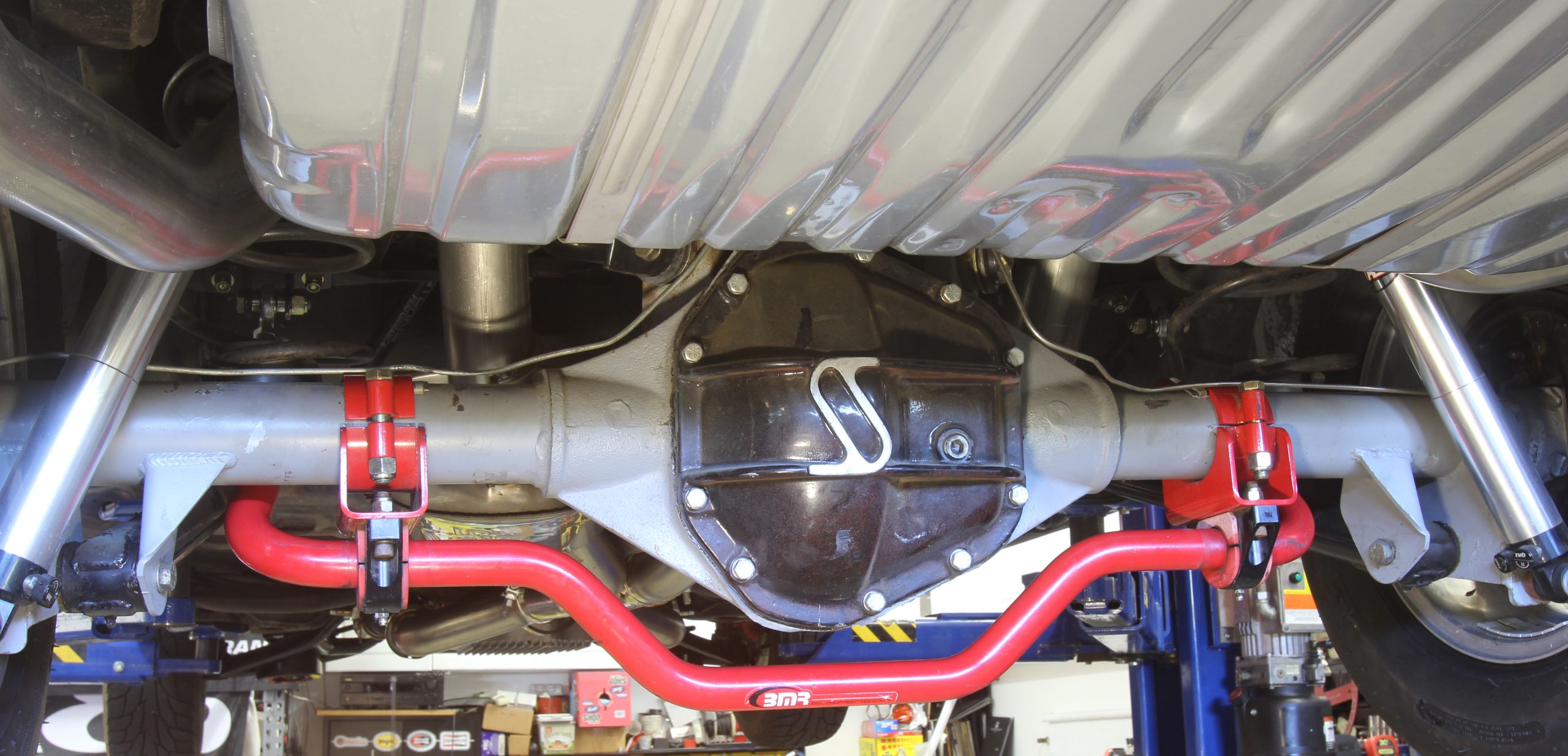
You didn’t mention if the car is equipped with a rear anti-roll bar. If the car is indeed as quick as the previous owner says, it should already have or will need a rear anti-roll bar. BMR sells a bolt-in kit that mounts the bar to the rear crossmember and the axle housing tubes. The bar is adjustable and you can input preload. If you install a new bar, don’t set any preload at first.
Cars that leave hard on the starting line without a rear anti-roll bar tend to pick up the left front corner and twist the body. That in turn squats the right rear corner. At this same time, the rear axle housing is trying to plant the left rear tire and lift the right rear. This is why cars not equipped with positraction or a limited slip device always spin the right rear tire.
If the Tempest is still using the factory upper and lower control arm mounting points for the rear suspension, it’s best to add a stiffener bar between the front lower control arm and the upper front control arm mounting points. Chevrolet began including these braces on big-block Chevelles in 1966. This brace ties the lower control arm to the upper and prevents tearing the upper crossmember. (Make sure the upper crossmember is not torn from its mounts on the frame too). Not having the lower to upper arm brace could be why the car pulls to one side during the launch.
Ultimately it would be a good idea to weigh the car on four individual scales to check weight distribution. What you are looking for is somewhat equal weight distribution between the left and right rear tires. If there is 50 pounds or more on the right rear compared to the left side, that might indicate why the car is pushing to the left under acceleration. This will need to be measured with the driver in the car.
There’s a lot more to getting your car to hook up with all the power it appears you have. Doing these checks can help eliminate many of the variables, and the car will likely hook up and run straight down the track!
Parts List
BMR Xtreme Rear Anti-Roll Bar BMR-XSB007H
UMI Performance Control Arm Reinforcement Brace Kit UPI-4028-B


Comments