
I’ve been reading about how to figure compression ratio by using a cc burette to measure the combustion chamber volume. But that appears to be only half the battle. What do I do about determining the volume of the piston in the bore? Could you explain how to do this? Thanks
D.B.
***
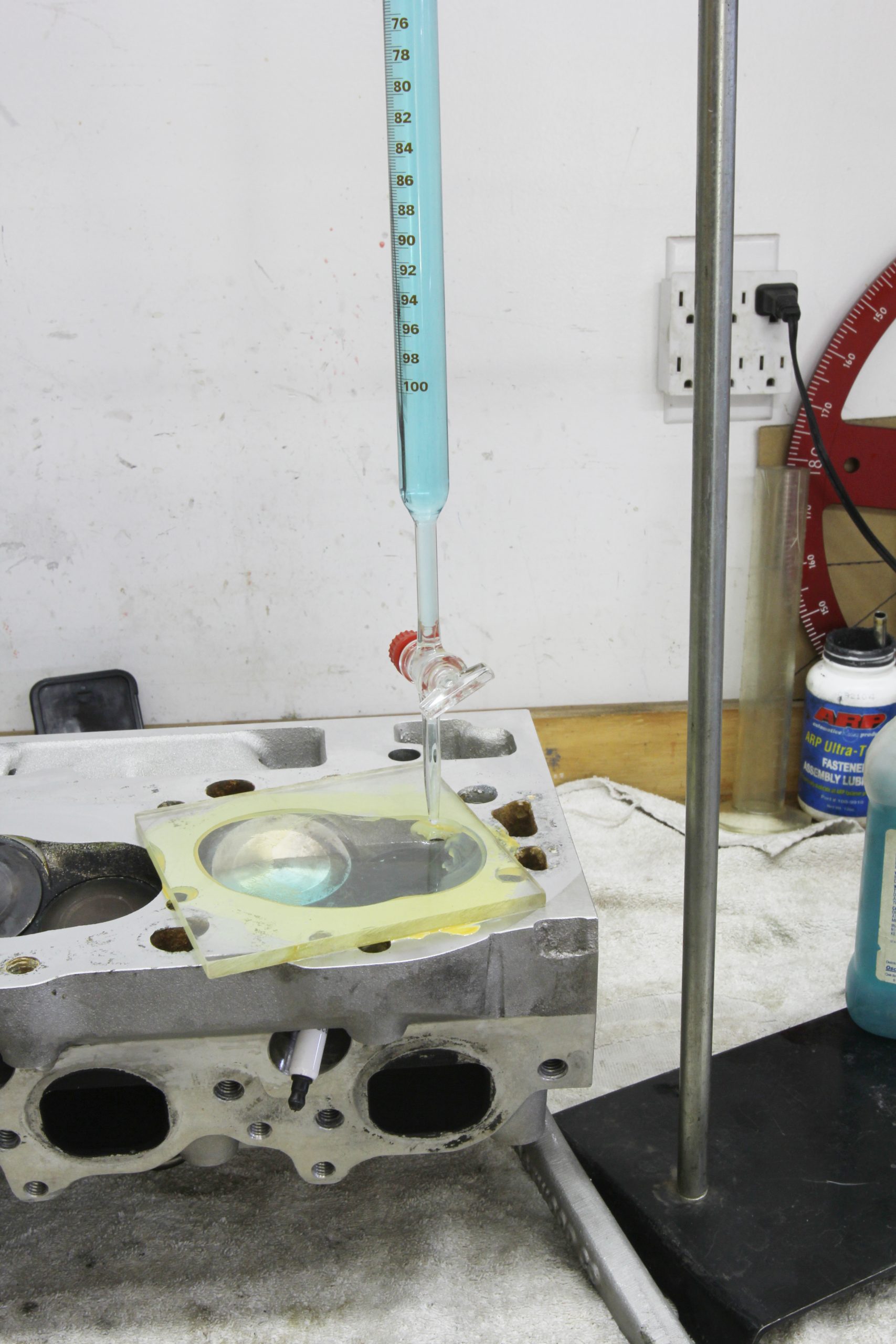
The process is actually very similar to measuring the combustion chamber volume. For those who may not be familiar with measuring the chamber volume, you will first need a way to measure the volume. Summit Racing offers several CC kits that will get your there. The best way is with a 100ml graduated burette like you might have used in high school chemistry class.
Notice that we called it a 100ml or milliliter burette. One milliliter is exactly the same volume as a cubic centimeter (cc) so even though the graduations are in ml, the volume is the same. There are several measuring kits available. The traditional kit uses a long, thin, 100ml glass burette with a valve at the bottom using a metal stand for support.
These tools aren’t cheap, but do a great job.
A more budget-friendly option is a Summit Racing cc kit with a larger 100cc graduated vial and a plexiglass cover for the combustion chamber. With this kit, you cover the chamber and then carefully pour the liquid from the vial into the chamber through its small hole in the plate. This works the same way you just have to work carefully not to spill any liquid from the vial which will affect the accuracy of your measurement.
How to Determine the Volume of a Piston in the Bore
Moving to answer your question, this system is intended for engines where you do not have accurate information on perhaps the dome volume or the volume of the valve reliefs or the volume of a dish in the piston.
First, you need to establish a known depth of the piston in the bore. Let’s place the piston 0.100 inch below the deck. We need this distance to calculate the volume of a true cylinder and a perfectly flat top piston – which would be the bottom of the cylinder we’re calculating.
The formula for figuring the volume of a cylinder is Pi (3.1417) x radius x radius x depth of the cylinder—or Pi R squared.
Let’s use a 4.00 inch bore as our cylinder diameter. The radius calculation would be 4.00 / 2 = 2 inches. So our formula would then be 3.1417 x 2 x 2 x 0.100 inch = 1.2567 cubic inches. But we will need to work in cubic centimeters so we have to convert cubic inches to cc’s. One cubic inch equals 16.387 cc’s so 1.2567 x 16.387 = 20.6 cc’s.
This 20.6cc’s is the volume of a perfect cylinder that is 4 inches in diameter and 0.100 inch deep. Now we need to actually measure our piston assembly in the cylinder with the piston 0.100 inch down from TDC. Let’s say that we have a piston with a very slight dome but it also has deep valve reliefs. Placing the flat plate on the deck surface and measuring the volume with the piston 0.100 inch down from TDC, we come up with 26cc’s of volume.
Given that the measured volume is only slightly more than the calculated volume of a perfect cylinder, we know that even with a slight dome, the piston measures more like a dished piston than a domed piston. This is because the valve reliefs are much deeper than the volume of the dome. Doing the math is 26 – 20.6 = 5.4cc worth of volume greater than a pure flat top piston. What we can do is input 5.4cc as a negative number in the piston volume category to represent a dished piston.
The easiest way to compute the compression ratio would be to use the free online Summit Racing compression ratio calculator and plug in the numbers. Let’s assume we have a 4.00 inch bore, a 3.48 inch stroke small block Chevy. Let’s also say we have a 64cc combustion chamber cylinder head and a slight 5.4cc dish volume piston. We are going to use a head gasket with 0.038 inch thickness and that the piston sits just 0.003 inch below the deck surface.
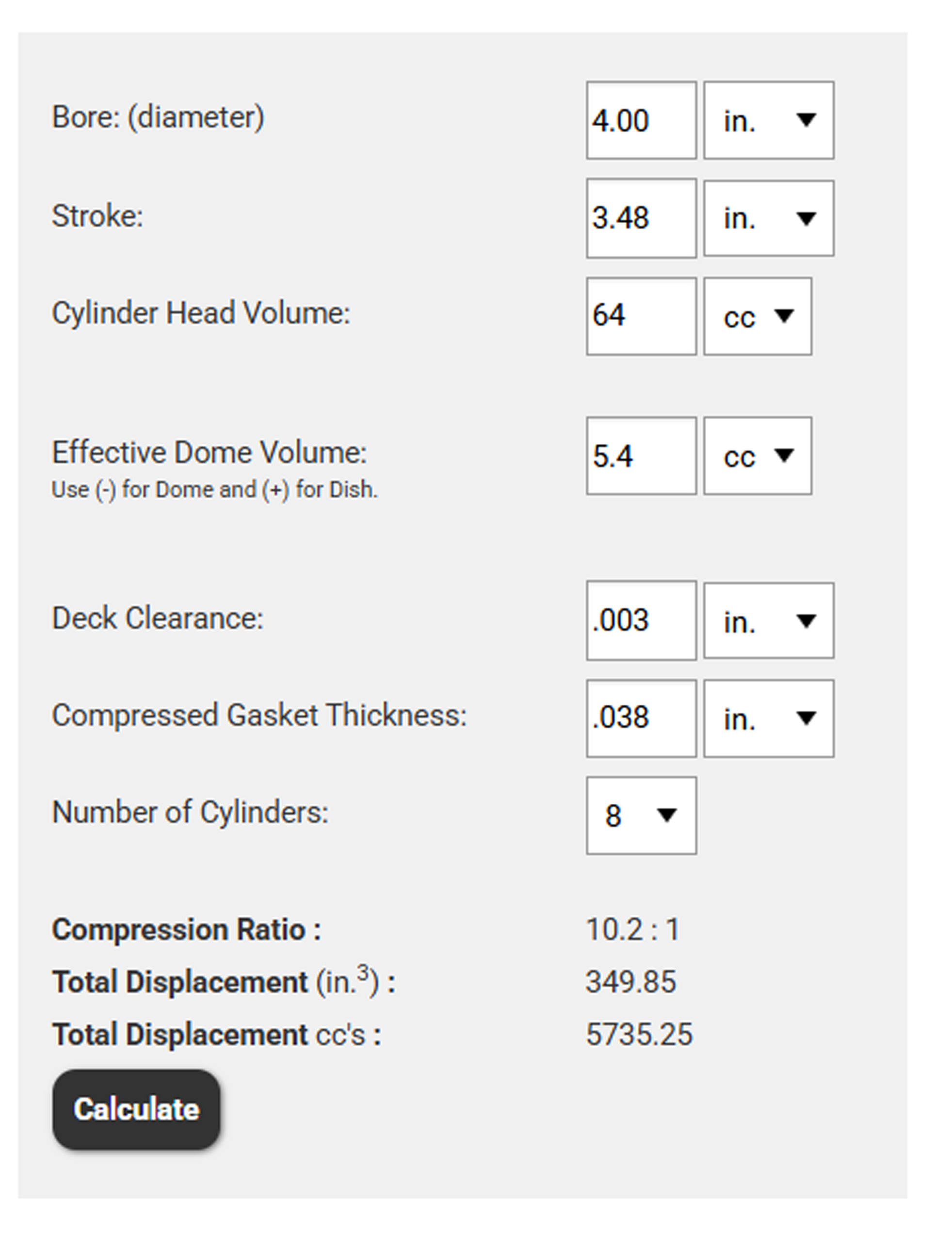
Inputting all the data into the program gives us a 10.2:1 compression ratio. This is a much more accurate computation because we measured everything as opposed to just inputting data from a piston catalog. One thing worth mentioning is that we are also measuring a tiny volume that is right between the top of the piston and top of the upper ring. This is worth maybe 0.1cc of volume but it is there nonetheless.
Hope this helps with your compression ratio calculations.
Cylinder Volume Measurement Parts List
- Comp 100cc combustion chamber kit – CCA-4974
- Summit Racing cylinder head cc kit – SUM-980180
- Proform 10cc burette kit – PRO-66831


An easier-to-remember formula, which is the same as used for engine displacement:
bore x bore x .7854 x stroke x #ofcylinders
So for a 4″ piston 0.100″ down the hole that’d be
4 x 4 x .7854 x 0.1 = 1.25664
No radius, no remembering Pi. Just bore and stroke and .7854 (the buttons for which fall into a neat little pattern on any standard calculator).