
I have a complete Chris Alston front suspension for my 1970 Chevelle. I’ve got it all installed but need to know how you adjust it to properly align everything for drag racing. I know there is a lot to do there but I’m trying to get the right info in simple terms. I don’t want the car going down the road sideways.
By the way, the body is off frame at the present time to do resto body work. It is a show car with an occasional trip to the drag strip.
Thank you for your help.
G.S.
We can help you get the front suspension dialed in, but before we get started it’s important to mention that the car must be completely assembled at race-ready weight with the front and rear ride heights set where you want them. This is a critical step some enthusiasts may not be aware of. Front and rear height affect all front suspension alignment adjustments. This ride height spec also needs the equivalent of driver weight in the driver seat. If you weigh 200 pounds, then you should put 200 pounds of weight or a person of equivalent weight in the car so that the alignment is accurate.
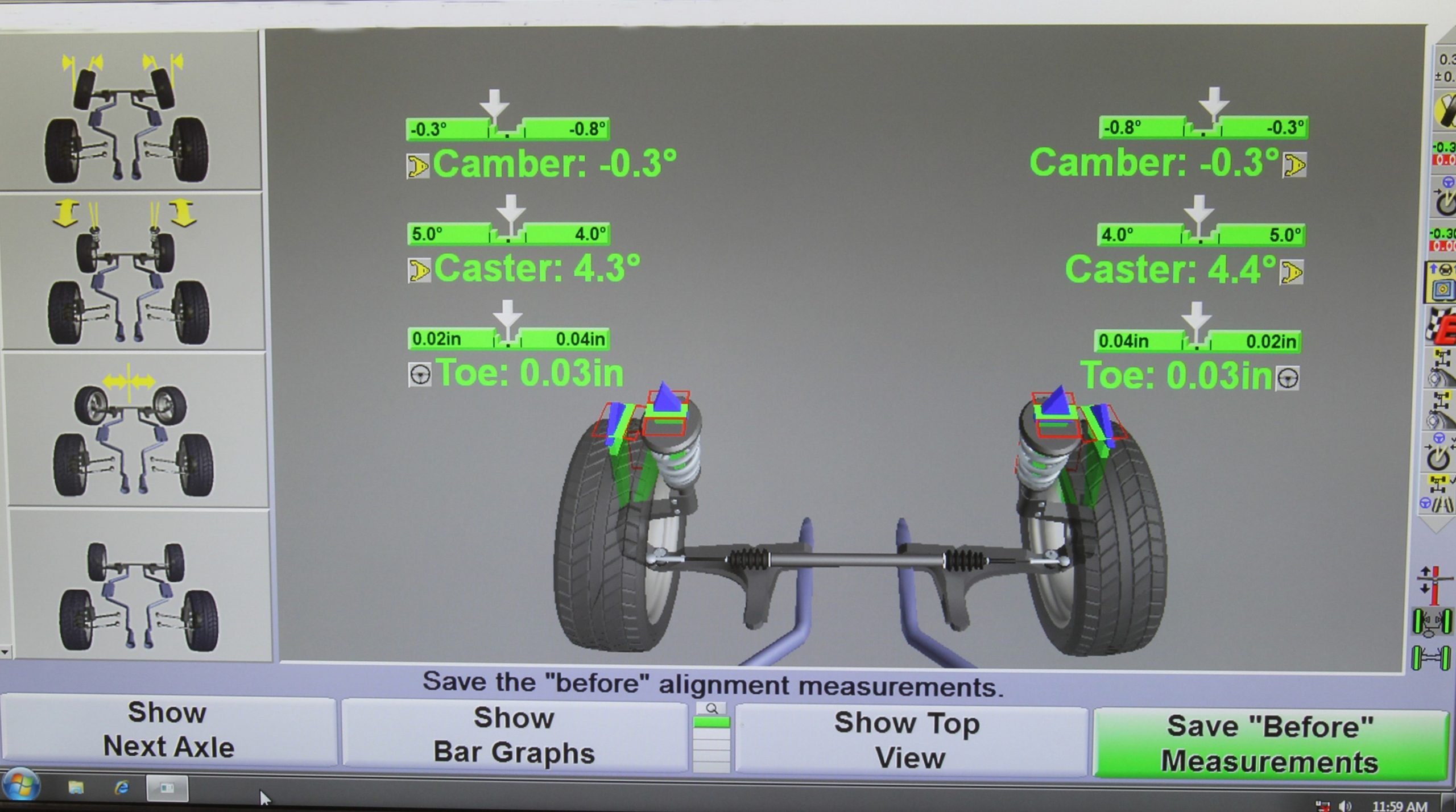
The three adjustments to a front-end alignment are caster, camber, and toe:
Caster is the tilt of the front spindle as viewed from the side. Negative caster is where the top of the spindle is tilted toward the front of the car. Positive caster tilts the top of the spindle toward the rear of the car. Positive caster is what you want as this improves high-speed stability.
Camber is the tilt of the spindle as viewed from the front of the car looking rearward. Positive camber is where the spindle tilts outward, away from the center of the car. Zero camber puts the spindle (and the tire) straight up and down with no angle. Negative camber tilts the top of the spindle in towards the center of the car.
Toe is the difference in length between the leading edge of the tire versus the trailing end. This is best visualized by imagining you are above the front end of the car looking straight down. Toe-in is where the distance between the leading edges of the front tires is a shorter than the trailing edge. The opposite, toe-out, is where the leading edge of the front tires is further away than the trailing edge.
All three of these factors are interrelated. Changing ride height or even one adjustment like camber will also affect the other two.
From your question, we will assume that you are looking for some alignment specs for your Chevelle. You mentioned it will be used for drag racing but it is also a show car. That’s not really a problem. For a pure drag race car, we would suggest setting the front suspension a little differently than for a street car. We’ll go over those two and throw in specs for performance street handling. Refer to the Alignment Specs chart below.
If you’re going to farm out this operation to a shop, first make sure they will do the job using your specs. Many alignment shops will only set your car to the original factory settings. Most modern shops use computerized alignment racks that tell the technician what to do. Some techs may not be familiar with how these specs affect handling—they only do what the machine tells them to do. There are shops that will do custom alignments, but you will have to do some hunting to find one.
The factory specs for your car were not intended for modern driving with radial tires. The original specs called for a positive camber setting, which is not what you want to improve handling in the corners. Since your car is a custom application with aftermarket components, the stock specs should not be used.
Let’s start with the drag race alignment. In this situation, we’re looking at minimizing the effect of the front tires on straight line acceleration. You will need to jack the car up from its established ride height and make all the alignment settings based on this. This will simulate the average front suspension height during acceleration. One inch higher than ride height is the typical place to start, but you can change this figure if need be.
What is hidden in the suggested alignment figures is something called bump steer. This is the amount of toe change that occurs when the front end rises under acceleration. The first one inch of travel does not change the toe all that much. If you allow the front end to rise to the point where the stock bump stops prevent it from rising further, this can create a situation where the toe change can be important.
As an example, we took the time to measure bump steer on the stock front suspension of a 1965 Chevelle, which is very similar to your car. We found that toe-in increases roughly 1/32-inch when the front end rises one inch. If you start with a slight amount of toe-out, this will negate the toe-in and create a near-zero toe position under acceleration.
We discovered what we thought was a huge toe-in problem with the same car at the drag strip. We fixed the issue on this 12-second car and found no improvement in either ET or MPH. It’s still worth checking, and could easily be worth a slight improvement in ETs for a 9- or 10-second car.
Note that both the drag race and high performance street adjustments in the chart are very similar. The difference is where you will be setting the specs for drag racing. With a street car, you set these specs with the car at ride height with driver weight in the cockpit.
We are not familiar with the Chris Alston Chassisworks front system, but we’ll assume it includes tubular upper and lower control arms that are stronger and create a better camber curve. With a taller spindle, the camber curve changes significantly compared to the shorter, stock spindle. We don’t have the space here to get into all the changes, but essentially the camber curve with a taller spindle changes dramatically when loaded. It generates more negative camber when the spring is compressed and more positive camber when the front suspension rises.
All of these are issues you might want to consider when setting your front suspension alignment specs. If you can’t find a decent shop to do your alignment, you can always purchase some tools and do the work yourself. This way you can set alignment specs exactly where you desire, and you’ll learn first-hand how changes affect the real-world results.
Alignment Specs
Caster and camber are expressed in degrees while toe is expressed in inches. The asterisk for the drag race alignment indicates that the settings should be made with the front end raised one inch from ride height to simulate acceleration on the drag strip.
| Alignment Spec | OE | Drag* | Performance Street |
|---|---|---|---|
| Caster | Positive 0.5 to 1.0 | Positive 4.0 to 6.0 | Positive 4.0 to 6.0 |
| Camber | Positive 0.5 | 0 to Negative 0.5 | 0 to Negative 0.5 |
| Toe-in | 0.24″ | 0.0625″ | 0.0625″ to 0.125″ |


Comments