
I picked up a 1969 L72 427. It has a stock short block with 11:1 pistons, a forged steel crank, and four-bolt mains. I’m using a COMP Cams 270 hydraulic flat tappet cam. My machinist said I should use #049 open chamber heads to run pump gas. I think that would cause too much compression loss. I do have a set of early #702 heads. Will they work and what compression ratio could I expect? I have no problem getting 100 octane leaded fuel.
M.J.
This is a common issue with older big block Chevy heads. The pre-1970 heads have a smaller closed combustion chamber design compared to the post-1970 heads with larger open chambers. However, just using any open chamber head to replace a closed chamber version does not guarantee the compression will significantly change. It all depends upon the casting you select.
Let’s get into the specifics to show you how the compression changes. First, we must make some assumptions about your combination. We will be using the Summit Racing Compression Ratio Calculator to compute different ways to achieve a desired ratio. This is a great program that saves the hassle of doing these calculations on paper. This writer is old enough to remember spending hours using the long-hand formula and a calculator to figure this stuff out. It was no fun!
The original L72 427 used domed pistons and #291 head castings with a 109cc combustion chamber. Research indicates the pistons had a 36cc dome, but for our calculations we ended up using a 34cc dome volume with a piston height of 0.025-inch below the deck. Using these numbers, the 109cc combustion chamber size, and a 0.015-inch steel shim head gasket, we came up with a compression ratio of 11.1:1. This is probably higher than the production head; in our experience, 1960’s engines rarely had the compression the factory listed because of rather wide production tolerances.
You may have noted our piston deck height of 0.025-inch. If we add the piston compression height of 1.765-inches along with the half stroke (1.88 inches) and 6.135-inches of rod length, we get a piston height of 0.020-inch below the deck based on the 9.80-inch factory deck height spec. This could be tighter, but looser is probably more common so we will use 0.025-inch for the deck height.
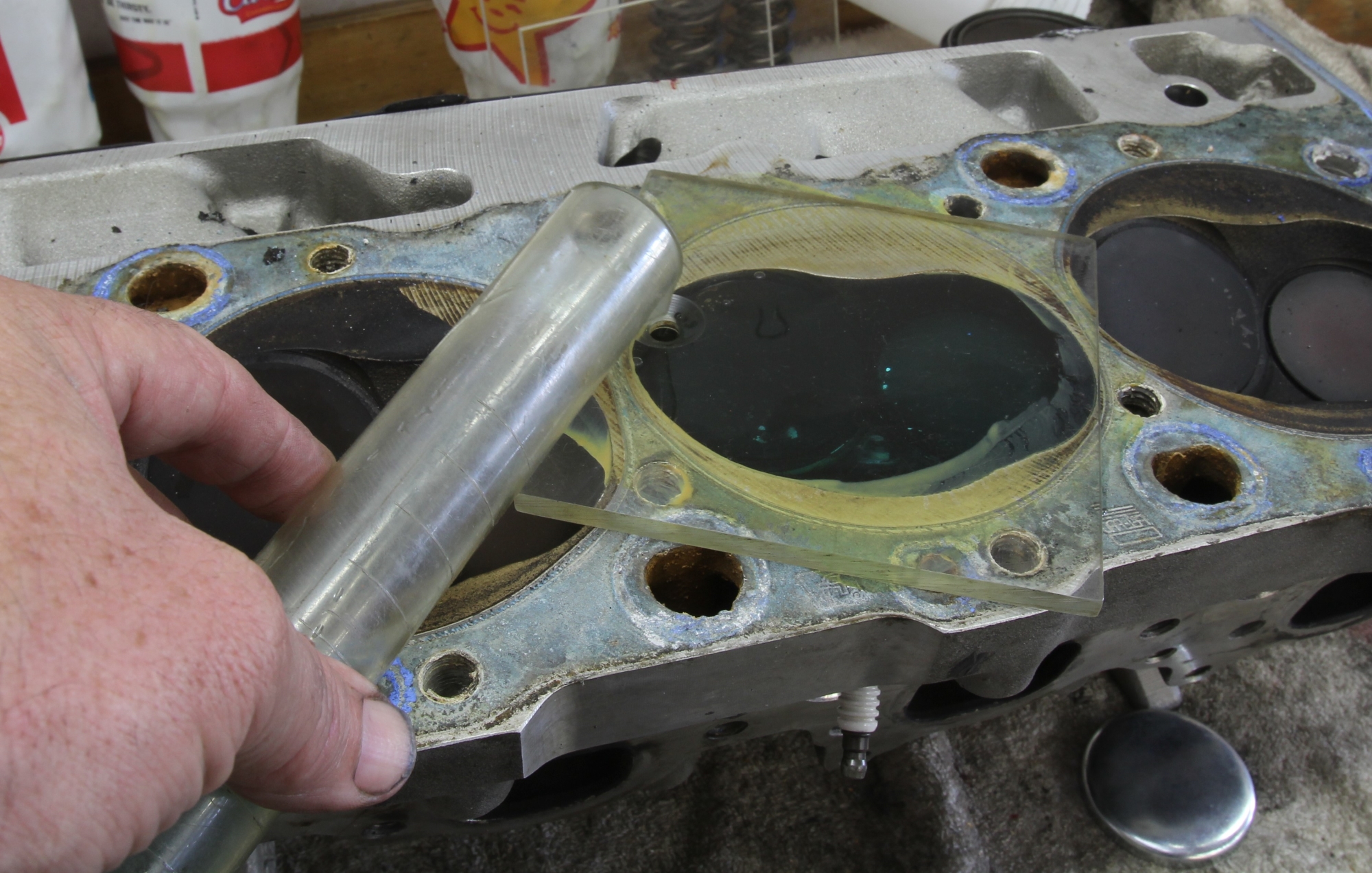
To answer your question, the 1969 L72 #291 rectangle port head had 109cc chambers with 2.19/1.72-inch valves. You said you had a set of #702 heads, which are oval port iron heads with 98cc closed chambers and smaller 2.06/1.72-inch valves. These heads will not work since the smaller chamber size will push the compression ratio higher, which is not what you want.
You mentioned that your machinist’s recommendation of the #049 head might kill compression, but the Summit Racing compression ratio calculator reveals this head might be a good move. The #049 head has 113cc chambers which are only 4cc larger than the stock #291 head. With all the other dimensions remaining the same, using the #049 head would drop the compression ratio from 11.1:1 to 10.67:1. This is a bit high for a street-driven big block Chevy on 91 octane pump gasoline, but it is a step in the right direction. In general, you want to keep the static compression below 10.5:1 for street use on pump gas.
Much of this also relates to your choice of camshaft. We will assume the COMP 270 hydraulic flat tappet cam you mentioned is a Magnum grind with 224 degrees of duration @ 0.050, a 110-degree lobe separation angle, and 0.510-inch lift on both intake and exhaust. This is a somewhat mild cam with short duration numbers for a big block Chevy, but it will make good cylinder pressure at lower engine speeds to help throttle response. The downside is combining a short duration cam with 10.5:1 compression could create detonation problems using an aggressive ignition curve on a hot summer day.
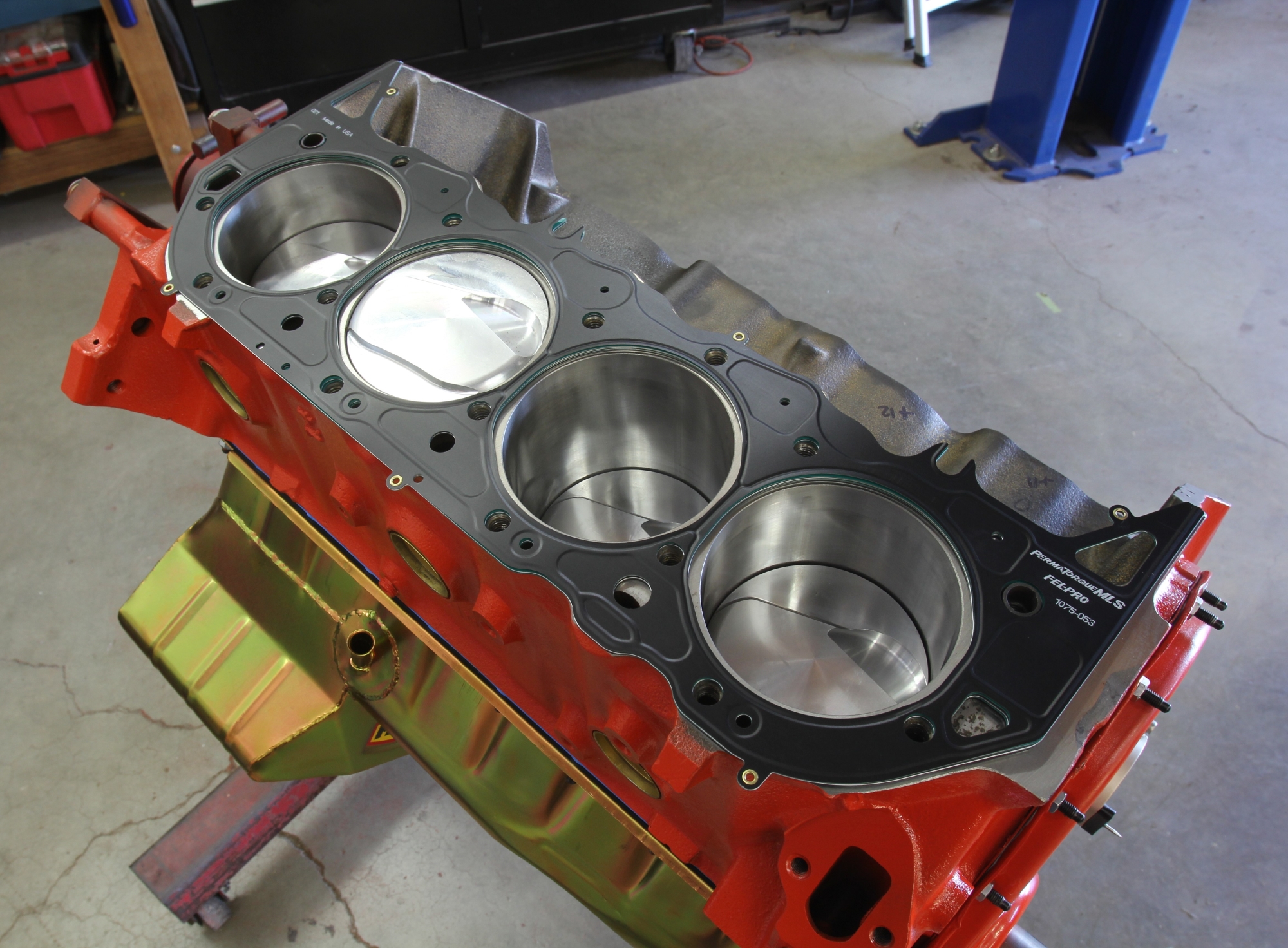
Let’s consider other options. For example, you could use a thicker head gasket to increase the overall volume above the piston. Our above calculations assumed a 0.015-inch thick steel shim head gasket. We looked through the Summit Racing catalog and found several potential gaskets. Using a 0.041-inch thick Fel-Pro MLS gasket will drop compression to 10.17:1. A Cometic gasket with 0.032-inch compressed thickness will nudge the compression back to 10.38:1. Another Cometic gasket with 0.027-inch compressed thickness reduces compression to 10.49:1.
Head gasket thickness not only affects static compression but also piston-to-head clearance. The tighter this clearance the more quench, or squish, you generate. This improves air/fuel mixture motion in the combustion chambers and helps reduce the engine’s tendency to detonate.
We’ve listed the part numbers for all three gaskets below. Good luck with your Rat project!
Parts List
Fel-Pro Performance PermaTorque MLS Head Gasket FEL-1017041
Cometic MLS Head Gasket, 0.032-inch CGT-C5329-032
Cometic MLS Head Gasket, 0.027-inch CGT-C5816-027


Comments