
I have a 1957 Chevy with a mechanical fuel pump. I would like to change to an electric inline pump but all of the pumps are supposed to be mounted below the tank. I would like to put the pump under the car on the passenger side. Will this work if the pump is above fuel tank?
T.M.
This is a great question and one that more car enthusiasts should really pay close attention to, because proper electric fuel pump placement is very important. I will assume for the sake of this answer that you are adding an electric fuel pump for more capacity for a carbureted engine in your ’57.
Vertical placement of the electric inline pump is important but so is the horizontal position between the engine and the fuel tank. The reason for this is that electric fuel pumps, and all pumps in general, are not nearly as efficient at pulling liquid into the pump as they are at building pressure. So to help this device to perform at its greatest efficiency, it’s best to mount the pump inlet even with the bottom of the fuel tank. If this is not possible, it should be no higher than the midpoint of the fuel level in the tank.
Your question made it sound like your pump placement will be farther forward and slightly above the tank level. Combining these situations will increase the difficulty for the pump to pull fuel the farther it is forward. If you mount it higher than tank level, we can almost guarantee that the pump will cavitate badly especially in warm weather.
Fuel Cavitation, Explained
Let’s explain what cavitation is and why it’s bad for pump performance. Pumps don’t really suck fuel in— they create a low pressure area at the inlet and use both the weight of the fuel in tank along with atmospheric pressure in the tank to push the fuel into the inlet. When the pump is located above the tank, this requires the pump to create an an increasingly lower pressure at the pump inlet to move the fuel into the inlet.
Gasoline is made of multiple chemicals all blended together. Some will boil at very high temperatures and pressures while others will boil at much lower temps and pressures. As the pressure at the pump inlet decreases, these higher ends of the gasoline will instantly boil, creating bubbles in the fuel line. These bubbles only add to the pump’s difficulty of making pressure. Eventually, this cavitation will become so aggressive that the fuel turns to a vapor. This is often referred to a vapor lock when the pump stops moving fuel.
The best approach is to a mount the pump to create an easier path for the fuel to arrive at the inlet. So again, locating the pump lower than the half-tank level and as close to the fuel tank as possible is the ideal placement for the pump.
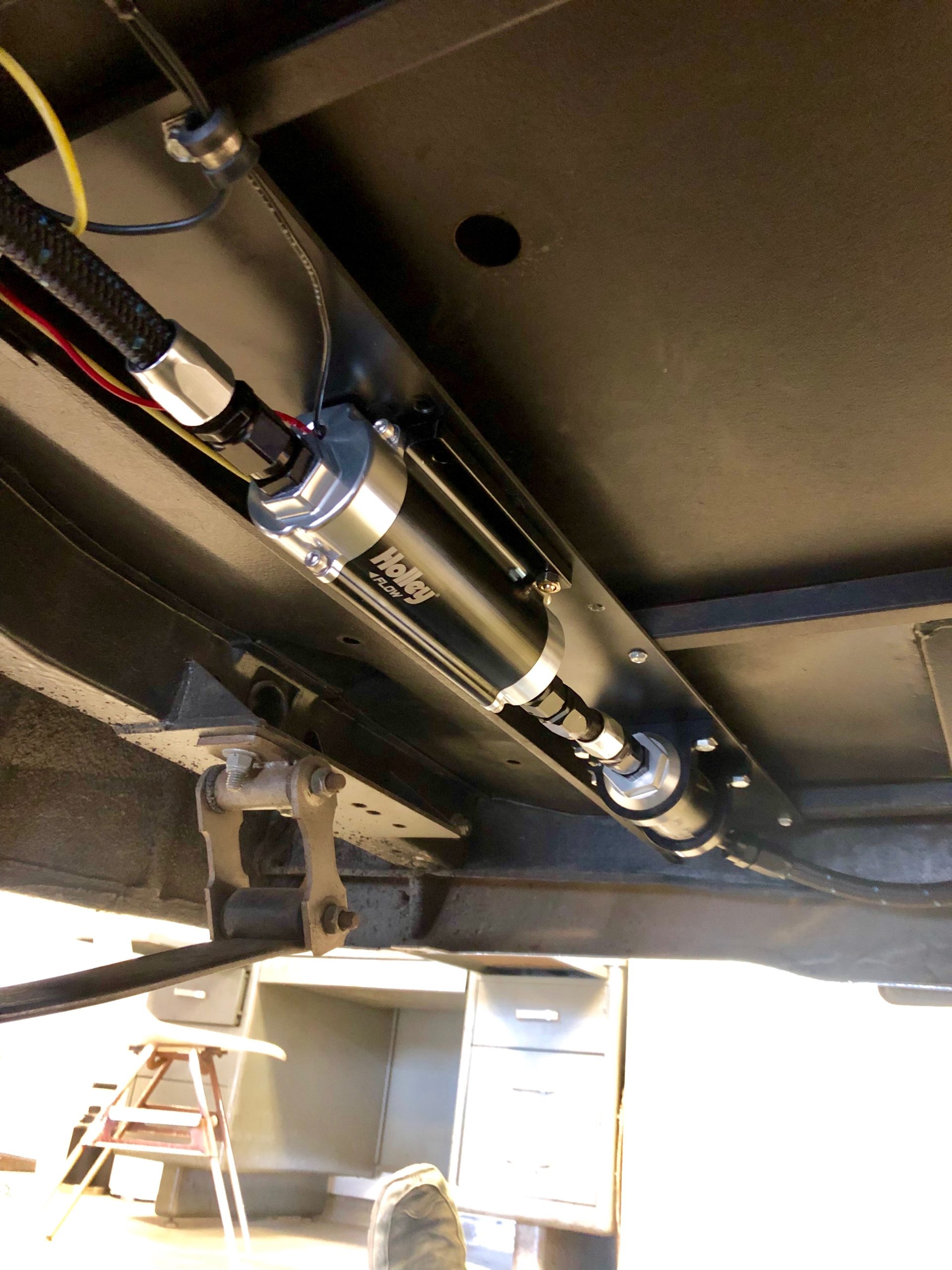
I have a favorite story about a hot rodder who didn’t follow these recommendations. He built a twin-turbocharged Nova making about 1,000 hp and was using an Aeromotive A1000 fuel pump. This is a very big pump that is more than capable of supplying sufficient fuel to feed this horsepower level—if the pump is mounted properly.
Unfortunately, he positioned the pump where it was convenient for him to mount it—on the kick-up portion of the trunk floor above the fuel tank. He then built a complete and very nice return system…
…but it didn’t work very well.
On the road, once the fuel level reached about half-tank, the pump was working so hard that it overheated and locked up. This was primarily caused by over-working the pump because it had to “pull” the fuel roughly around 10 inches vertically from the tank to the pump inlet. That was making the pump work very hard—which meant it was creating more heat.
What added to the problem was that as the level of fuel in the tank lowered to roughly half-full the fuel was now even hotter, caused by returning much of the fuel from the engine after it had a chance to be heated in the fuel rail. This package was mounted in an early Nova with a small fuel tank. At half full, the pump was returning the entire half-tank load of fuel in something like every six minutes or so. This further heated the fuel and contributed even more to its cavitation problem. Eventually, the pump locked up because it was running so hot that you could not touch the outside of the pump or it would burn your hand.
The car quit on him literally about a dozen times before he got together with Aeromotive and they dialed him in on how to relocate the pump and solve the problem. Once the pump was positioned near the bottom of the tank, the system worked flawlessly..
The point of this story is that the more you know about how pumps work, the more you will understand how to plumb a good fuel delivery system that can feed anything from a simple 300-hp daily driver to a 1,200 hp twin-turbocharged street monster. The basics apply to all applications.


Comments